

What are Management-Defined Performance Measures (MPMs)?
Management-Defined Performance Measures are performance indicators that a company’s management communicates externally but that are not explicitly defined by IFRS. Examples include:
Adjusted EBITDA: A measure of operating profitability that excludes depreciation, amortisation and financing costs and is often adjusted for one-off effects.
Adjusted Operating Income: A measure of operating profit adjusted for one-off effects in order to show the underlying operating performance.
Working Capital: A measure of short-term liquidity, calculated as current assets less current liabilities.
Free Cash Flow: A measure of the cash flow available after investments, often calculated as cash flow from operating activities less capital expenditure.
Organic Growth: A measure of growth excluding acquisitions or divestments.
Return on Invested Capital (ROIC): A measure of the profitability of invested capital.
Companies frequently use these indicators in investor relations presentations, annual reports and analyst conferences to communicate their performance.
The change: from voluntary to regulatory
Under IAS 1, MPMs were a matter of voluntary disclosure. Companies could decide which MPMs they wanted to disclose and how they calculated them. There were no uniform requirements for the calculation or for the reconciliation to IFRS indicators.
This led to a situation in which different companies calculated the same indicator differently, which made comparability difficult. One company might, for example, calculate “Adjusted EBITDA” without taking acquisition costs into account.
IFRS 18 changes this fundamentally. Companies must now:
-
Disclose MPMs that they communicate externally: Every indicator that management communicates externally must be disclosed in the notes.
-
Provide a reconciliation: For each MPM, a transparent reconciliation to the new IFRS 18 subtotals must be provided.
-
Account for tax effects and effects on non-controlling interests: The reconciliation must take all effects into account, including tax effects and effects on non-controlling interests.
-
Ensure consistency across multiple periods: MPMs must be calculated consistently across multiple periods.
-
Be subject to the annual audit: MPMs are now subject to the annual audit by external auditors.
Practical example: reconciliation of Adjusted EBITDA
To illustrate the requirements, let us consider a practical example: the reconciliation of “Adjusted EBITDA” to the new IFRS 18 subtotals. Suppose a company communicates an “Adjusted EBITDA” of 100 million euros externally. The reconciliation might look as follows:
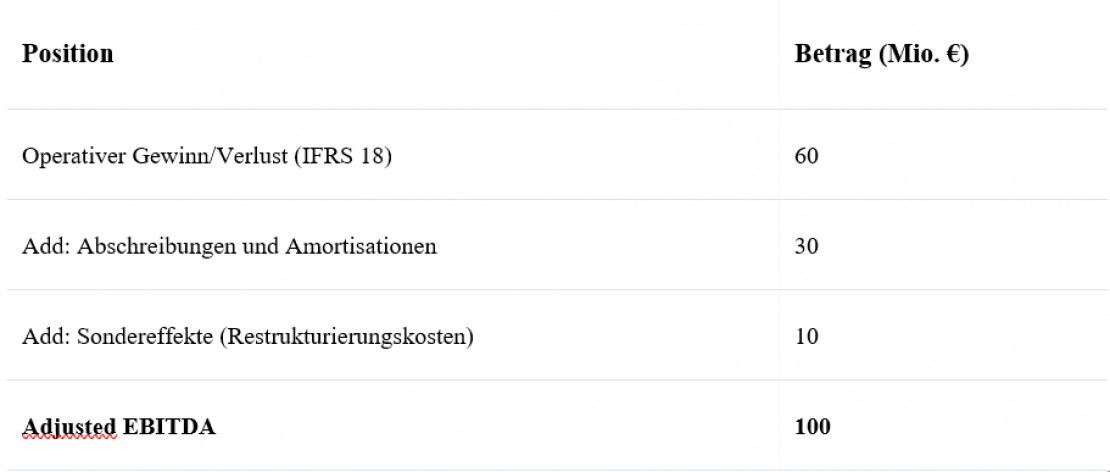
The reconciliation outlined here is a simplified representation. In practice, reconciliations are often considerably more complex, particularly when tax effects and the impact on non-controlling interests have to be taken into account precisely, which requires detailed analysis.
“Adjusted EBITDA” has so far often been used as a voluntary disclosure in management reports or investor presentations, where these “Non-GAAP Measures” allowed a certain amount of creative latitude.
With the introduction of IFRS 18, this changes fundamentally: in future, such indicators will become a mandatory part of the audited notes as Management-defined Performance Measures (MPMs). This marks a significant leap in compliance.
Whereas adjustments were previously often made without a detailed derivation, IFRS 18 now requires a strict reconciliation from an official IFRS subtotal, such as Operating Profit. In addition, the respective tax effects must be disclosed individually for each adjustment item (e.g. restructuring costs).
Selective “cherry-picking” of one-off effects is effectively ruled out by the new audit obligation and strict consistency requirements (changes must be justified and applied to the prior year).
The requirements of IFRS 18 in detail
IFRS 18 sets specific requirements for the disclosure of MPMs:
1. Identifying MPMs
Companies must first identify which indicators are MPMs. This includes:
-
indicators used in investor relations presentations
-
indicators used in annual reports
-
indicators used in analyst conferences
-
indicators used in press releases
-
indicators used in guidance or forecasts
This is a broader definition than many companies have assumed so far. Many companies will find that they have to disclose more MPMs than before.
2. Calculation and consistency
Companies must ensure that MPMs are calculated consistently. This includes:
-
consistent definition of the components of the MPM
-
consistent treatment of one-off effects
-
consistent treatment of acquisitions and divestments
-
consistent treatment of currency effects
3. Reconciliation to IFRS subtotals
For each MPM, a reconciliation to the new IFRS 18 subtotals must be provided. This reconciliation must:
-
clearly present all adjustments
-
account for tax effects
-
account for effects on non-controlling interests
-
be transparent and understandable
4. Explanations
Companies must explain why they use the MPM and how it is relevant for the users of the financial statements.
Governance and audit reliability
The requirement to disclose MPMs with complete reconciliations has significant implications for governance and audit reliability:
Governance requirements
Companies must establish governance processes to ensure that:
-
MPMs are correctly identified
-
MPMs are calculated consistently
-
reconciliations are correct
-
MPMs are subject to the annual audit
This often requires collaboration between different functions:
-
Investor Relations: identifies which indicators are communicated externally
-
Controlling: calculates the MPMs and prepares reconciliations
-
Financial accounting: ensures that the data is correct
-
Auditing: audits the MPMs and reconciliations
-
Legal department: ensures that the disclosure meets the requirements
Audit reliability
The reconciliations must be audit-proof. This means:
-
the calculations must be documented
-
the data sources must be traceable
-
the calculation logic must be transparent
-
changes must be traceable
This often requires the implementation of systems and processes that support audit reliability.
Practical challenges
Challenge 1: identifying all MPMs
One practical challenge is identifying all the MPMs that management communicates externally. This requires a thorough review of all external communication channels.
Solution: Establish a process whereby all functions that communicate externally (investor relations, marketing, management) regularly document all the indicators they use.
Challenge 2: consistency across organisations
Another challenge is ensuring consistency across different organisations, especially in groups with many subsidiaries.
Solution: Develop detailed guidelines for the calculation of MPMs and communicate them clearly to all organisations.
Challenge 3: tax effects and effects on non-controlling interests
Accounting for tax effects and effects on non-controlling interests in reconciliations can be complex.
Solution: Work closely with your tax specialists and auditors to ensure that these effects are correctly accounted for.
Challenge 4: system support
The efficient calculation and seamless tracking of Management-defined Performance Measures (MPMs) requires robust system support.
In the context of technical implementation in environments such as SAP S/4HANA or in Group Reporting in particular, it becomes clear that MPMs can no longer be maintained as isolated ‘Excel side calculations’ at the end of the consolidation process.
Instead, they must be embedded as an integral part of the reporting structure. This ensures the transparency and audit reliability at the touch of a button that auditors require.
Implementing specialised systems such as SAP Analytics Cloud, Hyperion or OneStream is therefore essential to ensure the precise recording and tracking of MPMs and to meet the new compliance requirements.
Best practices
Best practice 1: early identification
Identify all the MPMs you have to disclose at an early stage. This gives you enough time to implement governance processes and systems.
Best practice 2: clear guidelines
Develop clear guidelines for the definition, calculation and disclosure of MPMs. These guidelines should cover all aspects, including the treatment of one-off effects, acquisitions and currency effects.
Best practice 3: regular review
Review regularly (at least annually) whether your MPMs are still relevant and whether new MPMs need to be added.
Best practice 4: close collaboration with auditors
Work closely with your auditors to ensure that your MPMs comply with the requirements of IFRS 18.
Best practice 5: system support
Implement systems that support the calculation, tracking and disclosure of MPMs. This improves efficiency and reduces errors.
To meet the new requirements for audit reliability and transparency, companies should no longer maintain MPMs as manual “top-side adjustments” in Excel. A best practice is the integration of the reconciliation directly into SAP S/4HANA Finance or SAP Group Reporting, for example:
-
Clear account or movement-type logic: Use specific statistical accounts or sub-items to clearly flag adjustments (e.g. restructuring costs) at the point of recording.
-
Automated reconciliation: Map the MPM logic directly into the Financial Statement Versions (FSV) or reporting hierarchies. This allows the reconciliation from Operating Profit to Adjusted EBITDA to be generated at the touch of a button and with a full audit trail.
Conclusion: MPMs as a strategic governance topic
The transition to IFRS 18 makes MPMs a strategic governance topic. Companies that systematically identify, calculate and disclose their MPMs will not only ensure compliance but also improve their communication with investors and other stakeholders.
Investing in robust governance processes and systems for MPMs is an investment in the company’s credibility and transparency.