
ETO and CTO+: a brief description
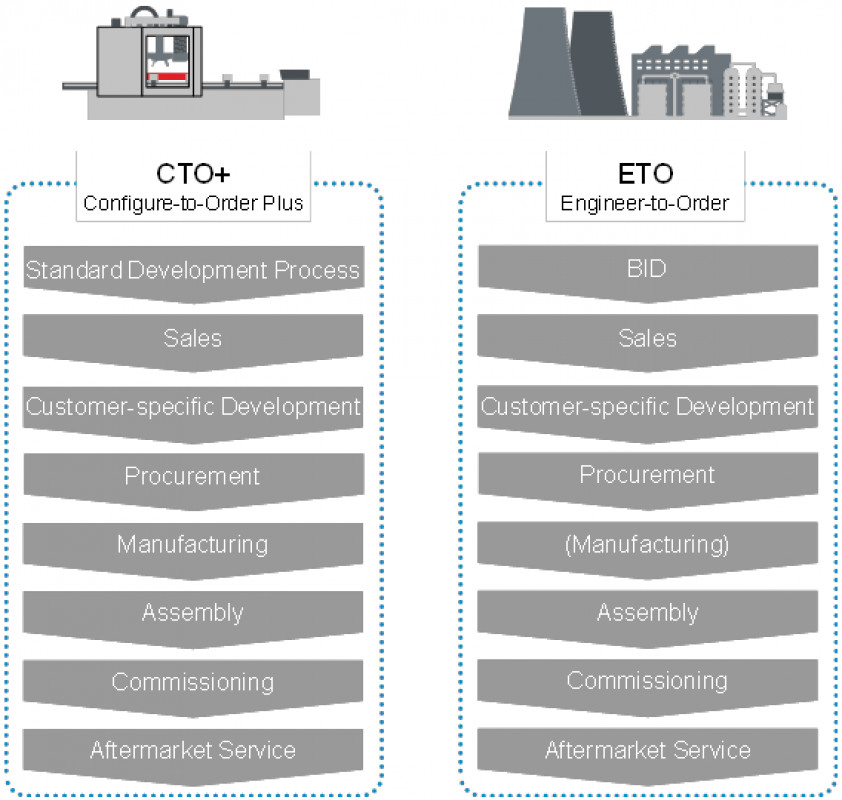
ETO (Engineer-to-Order) is a production approach characterised by the fact that the design work only begins once an order has been placed. As a result, the order-specific requirements are not fully known when the order is placed, although a rough alignment takes place during the bid phase. A large part of the design work therefore has to be carried out after the order has been placed. The ETO approach is distinguished by a high degree of product customisation for the customer.
CTO+ (Configure-to-Order Plus) is a production approach characterised by the fact that, for a given order, a standardised, variant-rich product is configured to meet the customer’s requirements. The design work for the standard product takes place before the order is placed. In CTO, customisation is limited to the variants of the product. The plus element (“+”) in CTO+ describes the ETO portion within a CTO order (for example material feed or foundations).
Why is this the case?
ETO carries many risks for the company:
- High conceptual risk: Because many products are highly complex, conceptual errors can arise during the design phase that are only discovered very late (too late).
- High customer influence: Owing to the total degree of customisation, the customer often dictates not only the properties of the product but also sets out conditions for the development process and project delivery. The company has to be able to adapt to these conditions afresh for each customer in order to win orders.
- High internal costs: A high level of staff effort, particularly in design, documentation and project management, increases overall costs and squeezes the margin. These costs arise as one-off costs.
- Competitive prices: the high internal costs lead to high sales prices for the products. Customers must also be able to afford these prices.
Set against this is the possibility of total product customisation for the customer in ETO.
CTO(+) offers the customer only part of this customisation. There can be an apparent customisation through configuration (CTO) and a real customisation (+). The real customisation is, however, restricted in order to carry out CTO+ successfully:
- Customisation may only account for a small part of the overall product.
- Customisation may only occur at certain points of the product (for example material feed).
- Customisation may only take place according to predefined conditions.
If we now transfer the risks of ETO to CTO, we arrive at the following result:
- High conceptual risk in ETO: By using standard building blocks, the conceptual risk in CTO is significantly reduced. The customisation is limited and so too is its conceptual risk.
- High customer influence in ETO: The customer’s influence, particularly on the development process, the documentation and project management, is pushed back in CTO. Work is carried out using standard building blocks with existing documentation and established procedures.
- High internal costs in ETO: By using standard building blocks, costs are spread across several orders, which lowers the average costs in CTO. Owing to the reduced customer influence, costs are also saved in development, documentation and project management through standardised processes.
- Competitive prices in ETO: The overall costs of the product fall significantly in CTO. Despite the lower level of customisation, the price becomes more attractive to the customer.
The customer therefore receives fewer options for customising the product, but in return gets a lower price and a lower conceptual risk.
This is all rather abstract. An example from a field that is at least partly familiar makes the process easier to understand: suits.
A quick Google search for the costs of different ways of making suits produces the following result:
- An off-the-peg suit in the upper price segment costs around 500 euros (MTS).
- A made-to-measure suit costs around 1,000 euros (CTO).
- A fully bespoke suit, by contrast, costs between 3,000 and 6,000 euros depending on the material and the workmanship (ETO).
From this simple, pared-down example we can already see the cost of individuality and the benefits of standardisation.
How is it possible to move from an ETO-driven organisation to a CTO-driven organisation?
This is where configuration management comes into play. According to Marcus Grande’s “100 Minuten für Konfigurationsmanagement”, configuration management is a management discipline for establishing and maintaining consistency between a product’s performance and its functional and physical properties.
In doing so, configuration management has the following tasks:
- Definition: Setting out the framework conditions for documenting the configuration (configuration management planning)
- Integrity: Ensuring the integrity of the product by means of a target definition and actual-state monitoring (configuration identification, configuration audit)
- Reproducibility: Reproducibility of earlier configuration states (configuration accounting)
- Transparency: Presenting the differences between configurations at various points in time (change transparency, change control)
As a rule, configuration management defines configuration items (also referred to as artefacts) within the product. A configuration item can be the entire product, a single component, or anything in between. The configuration item represents a product in its entirety. It is therefore not limited to the purely material view (comparable to a material master in SAP) but contains its documentation, historical states (baselines), incorporated and ongoing changes, as well as uses in orders and information about the physical representation (for example the SAP equipment).
Using the configuration item, the form-fit-function corridor can be represented transparently. The form-fit-function corridor, a term coined by Prof. Dr Jörg W. Fischer of the Steinbeis Transfer Centre for Computer Application in Mechanical Engineering (Form Fit Fuction Korridor – Jörg was machst du), describes the revision options of the configuration item from the perspectives of the stakeholders involved.
FFF is often defined from the design perspective, which causes problems particularly in service. An example of this: a bought-in part with defined connections can, from the design perspective, still be FFF following a revision by the supplier if its components change but the connections, function and form remain unchanged. From the service perspective, however, this may well constitute an FFF deviation, because different spare parts are now relevant for this bought-in part. A precise definition and monitoring of compliance with the revision process for a component or assembly, without active intervention in that process, is very helpful here when handled by an overarching body (giving rise to a dedicated configuration management function).
In ETO, the part is often defined and used only once for a single order, whereas in CTO the part is reused across various orders, which is why a view of the entire FFF corridor is essential here. An overarching body that holds responsibility for a configuration item promotes the correct positioning within the FFF corridor across the entire life cycle.
Where can configuration management help?
By defining, creating, maintaining and documenting the configuration item, ETO components, assemblies and products can be translated into units that can be used for configuration in CTO. The configuration items previously created in ETO can thereby be assembled into a new product within the CTO process and supplemented with ETO portions (which in turn can also become CTO-capable units). In doing so, configuration management keeps in view not only the design perspective with regard to FFF, but the entire life cycle of the configuration item. As a result, configuration management accompanies the transition from ETO-related units to CTO-capable units, promotes the stability of the units relevant to CTO and ensures their correct revision.
Configuration management can therefore actively support the step from ETO to CTO.
Do the benefits lie solely with the company, or does the customer benefit too?
At first, one might think that the move from ETO to CTO+ means the customer loses out. After all, they have to give up the option of total customisation. As we touched on briefly above, this is not the case. Configuration management brings additional advantages here too. For instance, one of its tasks is to monitor the product’s documentation. Especially for companies with high complexity, high conceptual risk and serious consequences in the event of failure or fault, complete documentation is essential, and this is why configuration management is already standard in these industries today, or even a legal requirement (for example railways, the military, aviation). As a result, the documentation of the standardised configuration items is generally much more professional and far more comprehensive than in comparable ETO projects. The customer therefore receives complete, accurate documentation that matches their product. The usual back-and-forth over documentation files and versions between the company and the customer is eliminated.
In addition to the documentation, the customer receives a standardised process for handling changes, which builds on the configuration items relevant to them. Changes during project delivery (for example through necessary revisions to standard products) or during the warranty and operating phase (for example due to obsolescence) can be passed on by the company, in a controlled manner, to the relevant customers together with all the relevant information (for example replacement configuration items). The customer therefore feels thoroughly and competently supported by the company and fully informed. This also has a positive effect on the company’s external image.
Thanks to configuration management, it is therefore not only the company that wins, but the customer too.