

The previous structure of the cash flow statement
The cash flow statement under IAS 7 is divided into three areas:
Cash flow from operating activities: the cash flow that arises from the company’s normal business activities.
Cash flow from investing activities: the cash flow that arises from investments in assets and investments in other companies.
Cash flow from financing activities: the cash flow that arises from financing activities such as taking out loans or issuing shares.
This structure has remained essentially unchanged since IAS 7 was introduced in 1992. It provides a clear separation between the different types of cash flows.
The changes under IFRS 18
IFRS 18 introduces two key changes to the cash flow statement:
Change 1: new classification of interest and dividends
Under IAS 7, companies had options when classifying interest and dividends.
Interest paid could be classified either as a financing activity or as an operating activity. Interest and dividends received could be classified either as an investing activity or as an operating activity.
IFRS 18 eliminates these options. The new rule is:
- Interest paid: financing activity
- Interest received: investing activity
- Dividends paid: financing activity
- Dividends received: investing activity
There are exceptions for companies whose main business activity lies in these areas (for example banks and insurers), but for most companies the classification is now unambiguous.
Change 2: operating profit/loss as the new starting point
Under IAS 7, the starting point for determining cash flow from operating activities using the indirect method was profit before tax. Under IFRS 18, the new starting point is operating profit/loss, one of the new subtotals that IFRS 18 introduces. This is a significant difference, because operating profit/loss does not include all financing costs and taxes.
Practical example: converting the cash flow statement
To illustrate the impact of these changes, let us consider an example.
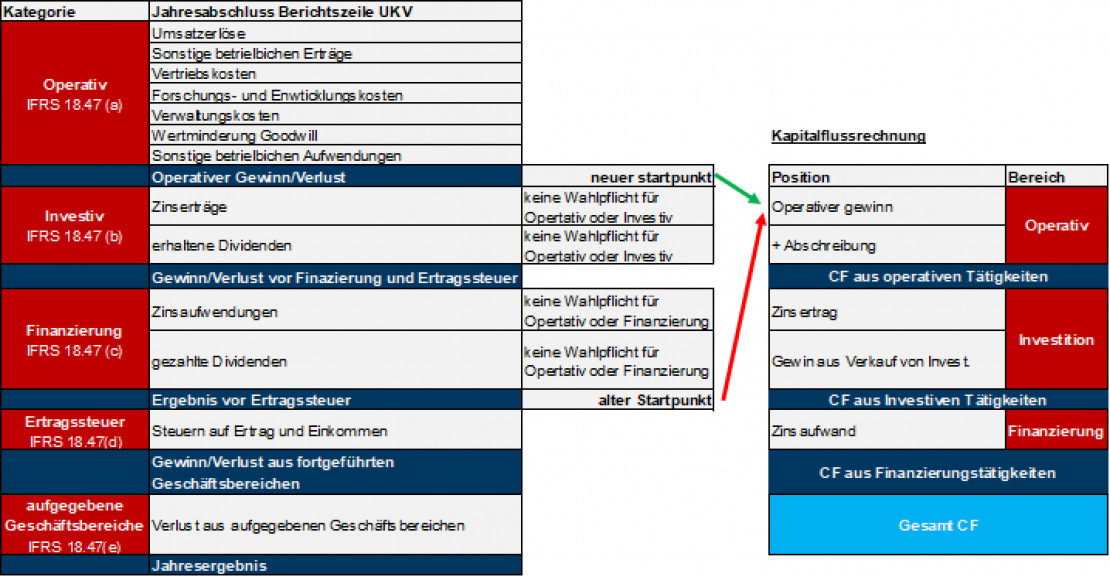
Conclusion: Because of the stricter categorisation of investing and financing activities within the income statement, the options no longer apply in certain cases, since these are now clearly extracted from operating profit. Operating cash flow may turn out to be lower and the cash flows from investing or financing higher.
Impact on liquidity analysis
These changes have an impact on liquidity analysis and on the interpretation of the cash flow statement:
Impact 1: operating cash flows may appear lower
Since interest income and gains from investments are no longer included in operating cash flow, operating cash flows may appear lower than before. This is important to understand, because it does not mean that operating performance is worse. It is simply a question of classification.
Impact 2: investing cash flows may appear higher
Since interest income and gains from investments are now included in investing cash flow, investing cash flows may appear higher than before.
Impact 3: comparability with previous years
When it comes to comparability with previous years, it is important to note that the classification may differ. Companies must reclassify the previous year’s figures to ensure comparability.
Challenges during implementation
Challenge 1: identifying all affected items
One practical challenge is identifying all items that are affected by the new classification rules. This requires a thorough review of all cash flows.
Solution: create a detailed list of all items involving interest, dividends or gains from investments, and check how these should be classified under IFRS 18.
Challenge 2: system adjustments
The cash flow statement is often calculated in systems (for example SAP or group reporting systems). These systems must be adapted to reflect the new logic.
Solution: work together with your IT teams to adapt the systems. This may include adjusting calculation logic, account mappings and reporting tools.
Challenge 3: retrospective application
The requirement for retrospective application means that companies must reclassify the cash flow statement for 2026.
Solution: start planning and implementation early, so that you have enough time to adjust historical data.
Best practices
Best practice 1: early planning
Plan the conversion of the cash flow statement early. This gives you time to adapt systems and establish processes.
Best practice 2: detailed documentation
Document in detail how items are classified under IFRS 18. This helps with consistency and with communication with auditors.
Best practice 3: review with auditors
Review your classifications with your auditors to ensure that they meet the requirements of IFRS 18.
Best practice 4: communication with stakeholders
Communicate the changes to the cash flow statement clearly to stakeholders, in particular to investors and analysts. This helps to avoid confusion and improve comparability.
Best practice 5: impact analysis
Carry out a detailed analysis of the impact of the conversion. This helps to identify potential problems early.
Impact on different types of company
Banks and insurers
Exceptions apply to banks and insurers. Since their main business activity lies in managing financing and investments, they can continue to include interest and dividends in operating cash flow. This is important to understand, because it means that the cash flow statement looks different for these companies.
Industrial companies
For industrial companies, the conversion is relatively straightforward. Interest belongs to financing activities, while interest income and gains from investments belong to investing activities.
Trading and service companies
For trading and service companies, the conversion is likewise relatively straightforward.
Conclusion: an important but manageable conversion
Converting the cash flow statement to IFRS 18 is an important change, but it is manageable. Companies that plan early and adapt their systems and processes systematically will be able to carry out the conversion successfully.
The new structure of the cash flow statement also offers benefits: it is clearer and more consistent, and it eliminates options that led to comparability problems.