
Normative and legal considerations
Before we address the question itself, it is worth briefly looking at the normative and legal situation to get a feel for how configuration management is used. As a rule, many industries regulate the requirements for the configuration management of their respective suppliers through their quality management requirements. Often, however, this is not limited to production and delivery, but continues as part of the maintenance of machinery and plant on the operator side. Examples of this include:
- Defence sector: the NATO guidelines (for example AQAP-2110) contain not only the requirements for suppliers of military equipment, but also set out guidelines for configuration management on the operator side (that is, the respective national armies such as the Bundeswehr).
- Aviation: for the European Union, the EASA (European Aviation Safety Agency) sets out the legal rules. These rules (for example EASA Part 21) are intended to ensure the safety and airworthiness of aircraft. To this end, the rules set out the framework conditions for both production and maintenance.
- Rail transport: the EU’s 4th Railway Package, represented in Germany by the Federal Railway Authority, sets out clear rules for operators of rail vehicles on how to map the vehicle itself, as well as the roles involved in the maintenance process.
In other words, configuration management is not limited to the production of a machine or plant, but considers the entire lifecycle of it.
What is the difference in how configuration management is used by manufacturers and operators?
The focus here is on the different objectives. Let us take the example of rail transport, specifically the manufacturer and the operator of a rail vehicle.
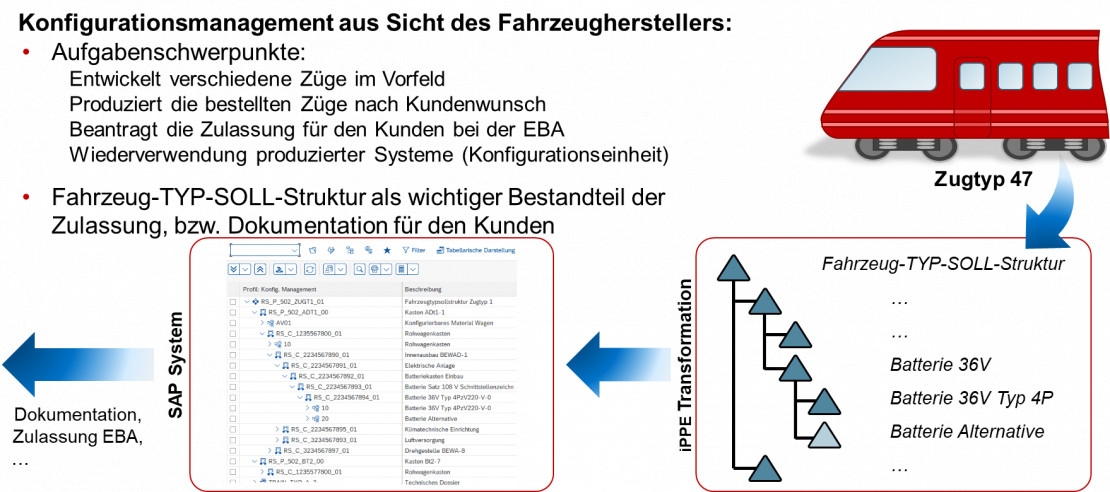
From the manufacturer’s perspective, configuration management serves to map a target configuration for the delivery of a vehicle or vehicle type. In addition to mapping the configuration, configuration management also serves to create configuration units, in order to significantly reduce development and production costs as well as throughput times over the long term through reuse (see also the previous article on the use of configuration management in the transition from ETO to CTO(+)). In rail transport, the vehicle is approved by the vehicle manufacturer, so the target configuration also serves to approve the vehicle.
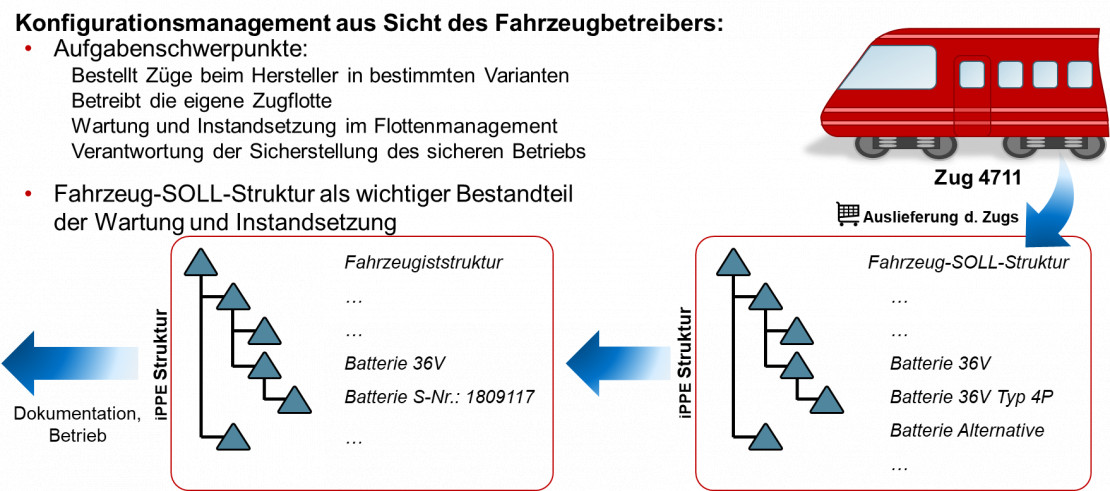
In contrast to the manufacturer’s perspective, the reuse of configuration units plays no role for vehicle operators. They do not want to develop new trains and therefore have no need to define reusable units in design and production processes. Their objective lies instead in checking the data supplied by suppliers and imported into the system, in identifying common parts across the entire vehicle fleet, and in defining a target configuration as a specification for the maintenance process. Changes must be mappable transparently and carried out seamlessly throughout the entire process.
Which structures are needed for the mapping?
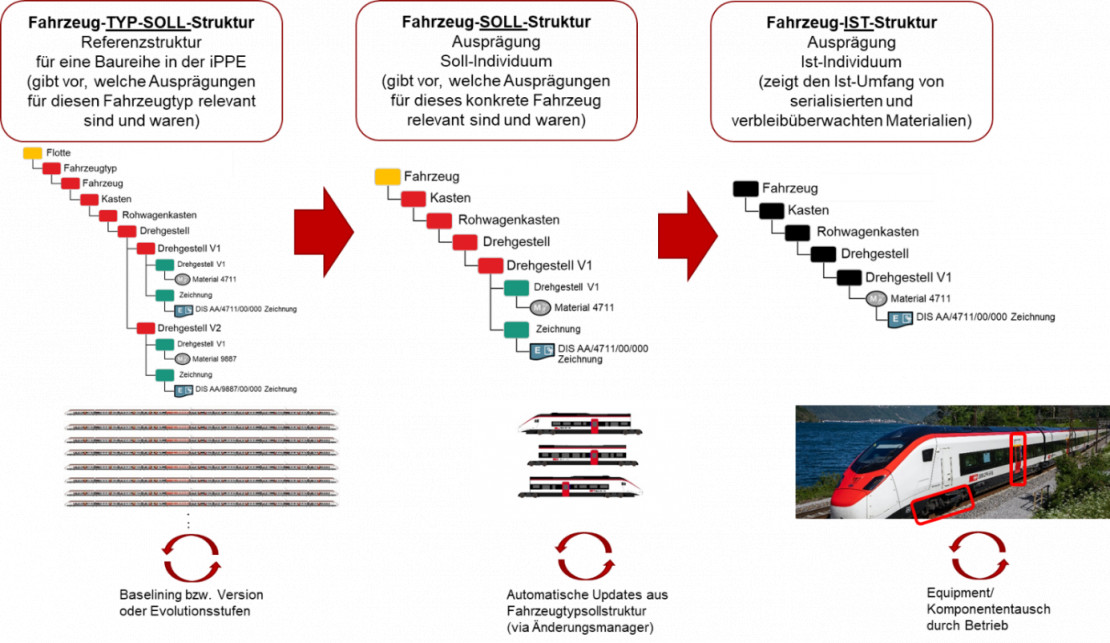
In order to map the operator’s requirements in configuration management, three structures are needed:
TYPE-TARGET structure: the TYPE-TARGET structure is the supplier’s handover structure. Until final acceptance (for example the end of the warranty), it contains the updates supplied by the supplier for a vehicle type. The TYPE-TARGET structure contains various variants of components and assemblies that may also replace or exclude one another, as these are in use on different vehicles of this vehicle type (different delivery states).
TARGET structure: in order to be able to map the different delivery states, a TARGET structure is needed for each vehicle. The TARGET structure contains the permissible configuration for a specific vehicle. It can include alternatives to components or assemblies that are valid in parallel for this vehicle. Serialised components are generally not listed individually, but are grouped together by quantity in the manner of a bill of materials. The target structure usually contains a considerably greater range of components and assemblies than the ACTUAL structure.
ACTUAL structure: the ACTUAL structure contains the components and assemblies that are worth monitoring from a legal perspective or from the vehicle operator’s perspective. These are generally serialised components and assemblies (for example wheelsets). Because of the effort involved in serialisation, the ACTUAL structure does not contain the complete configuration of a vehicle.
What is a configuration check?
The configuration check makes it possible, within the system, to check whether a newly fitted part may be used in this vehicle at this position when a defective or worn part is removed and its replacement is fitted. This involves not only the trivial check of identical removal and installation material. Cases such as alternatives, predecessor-successor relationships, or dependent materials in the same or other assemblies (for example when software is replaced) must also be taken into account here. To make this possible, a configuration check is carried out on the basis of the TARGET structure of this specific vehicle whenever the ACTUAL structure is changed (an order for removal and installation). If we take, for example, the removal of an air-conditioning unit and the installation of a successor model, this can affect the train’s required software version for control purposes, as well as temperature sensors mounted elsewhere. The configuration check therefore cannot be limited to a single material, but can relate to large parts of the TARGET structure. The result of the configuration check is presented in a configuration check log. Depending on when the configuration check is carried out (ideally for the first time when the material is picked for an order), the maintenance employee can identify whether the material to be installed can be used and whether there are dependencies on other components or assemblies.
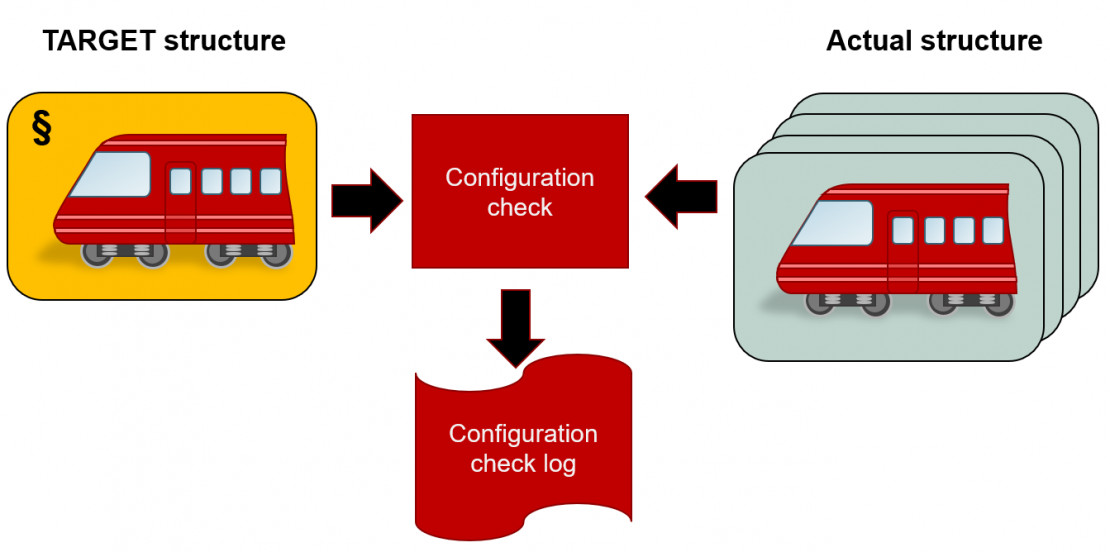
The demands placed on the configuration check are therefore high, but carrying it out correctly also massively reduces component-related errors during maintenance work and enables seamless documentation with reference to the target configuration of a vehicle.
Is configuration management only useful for highly regulated industries?
The industry examples and the very specific example of how configuration management is used by operators relate to highly regulated industries. Here configuration management and its use are already established and further developed (see the updating of the normative and legal foundations such as the 4th Railway Package). The question now arises as to what extent its use is also worthwhile in less heavily regulated industries. Let us take a look at the standards. ISO 9001, and with it the included ISO 10007 on configuration management, to whose QM guidelines many companies are certified, presupposes the use of configuration management. Beyond this, however, configuration management offers general benefits for the operators of plant too:
Safety and reliability: well-managed configuration management enables the operator to ensure that all components and systems are configured in accordance with the specified requirements and standards. This helps to ensure the safety and reliability of the plant or machinery and to reduce the risk of malfunctions or failures.
Efficient operating processes: by clearly documenting and tracking configuration changes, operators can achieve more efficient operating processes. They can ensure that all employees have access to current and accurate information about the plant or machinery, which leads to improved work performance and a faster ability to respond to changes or problems. Cost efficiency: well-executed configuration management minimises the risk of errors or unexpected problems during operation. This can lead to less downtime, fewer repairs and lower operating costs. In addition, an optimised configuration can help to use resources more efficiently and avoid unnecessary expenditure.
Compliance and certification: in many industries, particularly in regulated sectors such as aviation, healthcare or defence, operators are legally obliged to comply with certain standards and regulations. Effective configuration management supports the operator in meeting these requirements and eases the process of certification and compliance.
Long-term maintainability and development: by systematically managing configuration data, operators can improve the long-term maintainability and development of their plant or machinery. They can plan, implement and track changes in order to optimise performance and functionality over time and extend the service life of the plant.
Now back once more to our original questions
Can configuration management do more than simply convey information in a suitable form to the customer and thus to the operator of machinery and plant? And is the use of configuration management able to actively support the maintenance process?
Following the explanations above, both questions can clearly be answered with “yes“. Effective configuration management gives operators the ability to run their plant or machinery more safely, more efficiently and more cost-effectively, while at the same time ensuring compliance with standards and regulations.