
SAP Analytics Cloud Q2 2026
Targeted innovations for your financial controlling
Contents

The Q2 2026 Release of SAP Analytics Cloud (SAC) brings targeted improvements that are of high relevance to SAP Finance Managers and Controllers. Rather than generic marketing claims, we focus on the features that offer direct added value for your daily reporting and your analysis processes and that create digital clarity in your financial data.
1. Asymmetric reporting: precision and flexibility in financial analysis
Asymmetric reporting represents a significant advance within SAC. Until now, users were limited to having all the rows and columns of a SAC table follow the same structure, that is, the same dimensions, hierarchy levels and time granularities. This often led to compromises, or to the need to create several separate tables for different perspectives, which in turn increased the styling and maintenance effort.
With asymmetric reporting, this is now a thing of the past: each column or row range can now have its own visibility filter. This means you can flexibly define specific dimension members, hierarchy levels and time periods without affecting the aggregation logic running in the background. The result is a precise, solution-oriented presentation of complex financial data.
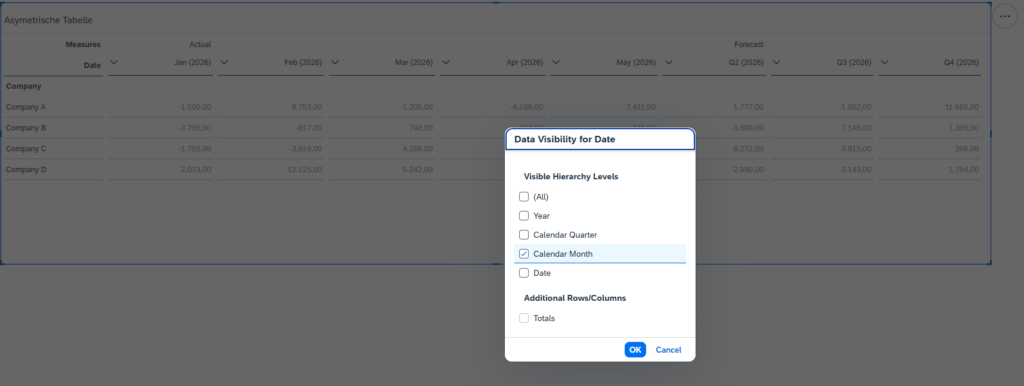
A practical example for controllers: Imagine you want to display monthly actuals from January to May 2026 at cost-centre level right next to an annual forecast on a quarterly basis. With asymmetric reporting, this is now possible within a single widget. The data is formatted consistently and can be maintained without any duplicate effort. Management reports in which actuals and plan or forecast data have to sit side by side at different levels of granularity have always involved a compromise. That compromise is now a thing of the past, which considerably improves the clarity and efficiency of your financial reports.
2. Decoupled data panel: an optimised workflow for story designers
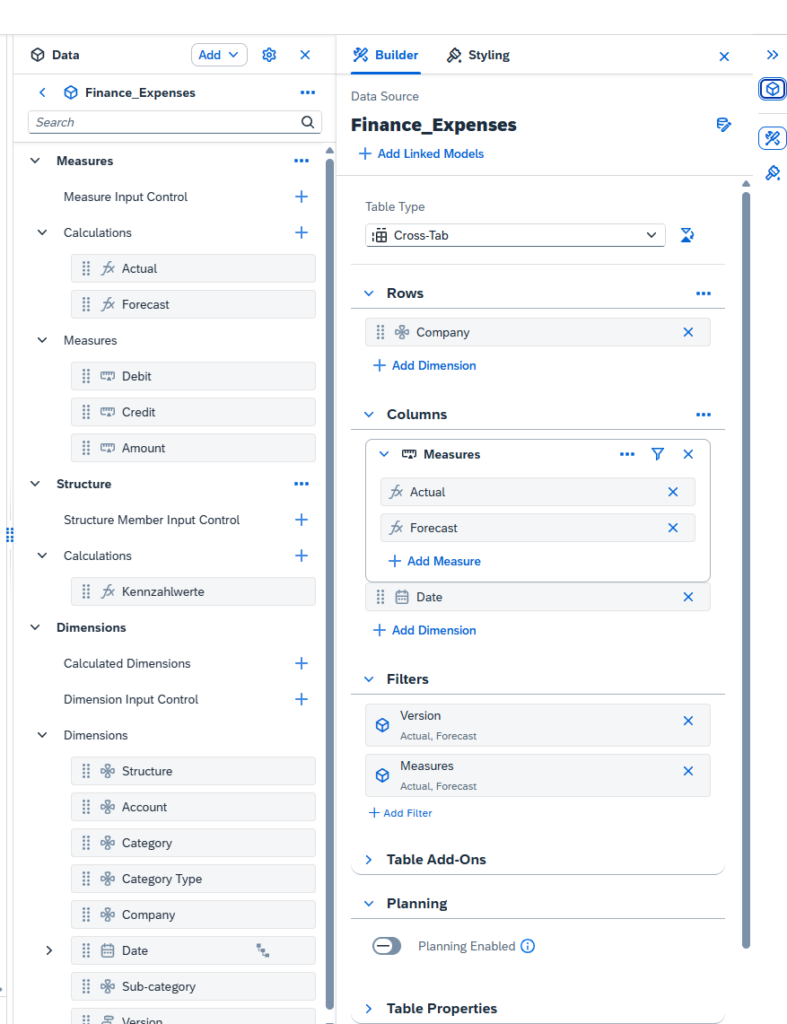
For users who regularly create stories in SAC, the constant switching back and forth between the data panel, the builder panel and the styling panel was often a challenge. Until now these three panels were closely linked, which could mean losing your current view when switching between the data source and the layout settings.
The data panel is now decoupled and can be opened independently via its own button in the right-hand toolbar. This change is primarily a simplification of the workflow rather than new functionality in the strict sense. While occasional users may hardly notice the difference, for active story designers it is a tangible relief in their daily work. It helps to increase efficiency when creating and adjusting reports and to optimise the user experience for power users.
3. Composite versioning: greater security for reusable building blocks
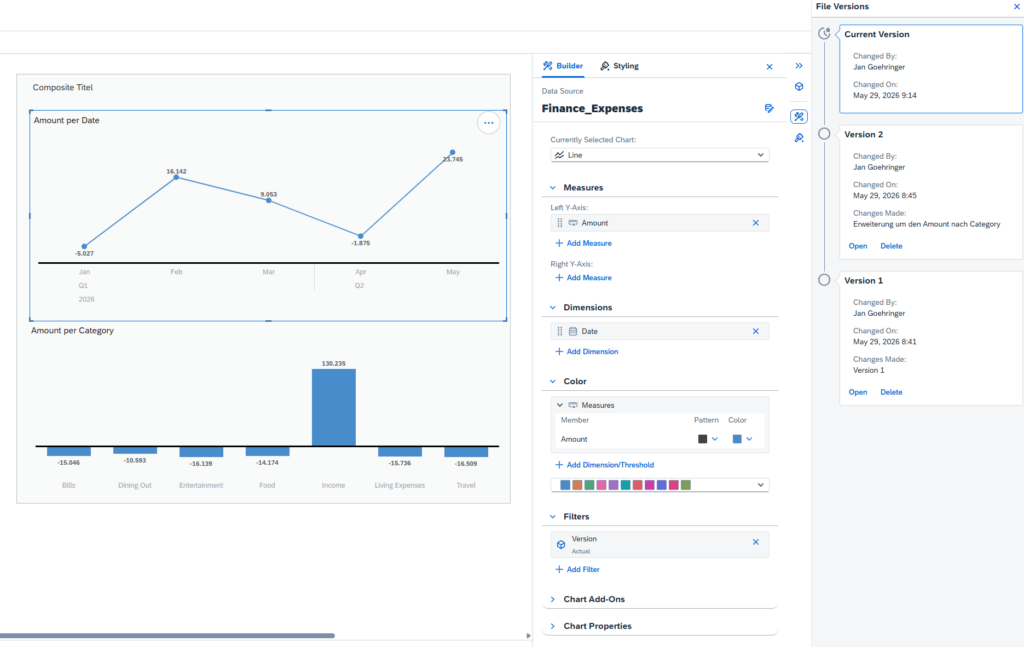
Composites are reusable chart or table building blocks that can be embedded in multiple stories. Until now, there was no safety net when making changes to a composite: anyone who went too far had to roll back manually. This was a particular risk for teams in which several developers work on the same composites.
From Q2 2026, composite designers can manage up to 10 versions and, where necessary, revert to an earlier stable version. Only one version is ever active and embedded in stories. This feature is especially relevant for teams in which several developers work on the same composites, as well as for scenarios in which a faulty update could disrupt a live dashboard. For individual developers or smaller installations the added value is admittedly modest, but for collaborative, future-proof development in larger environments it is a valuable addition.
4. Data Export API in the Job Monitor: transparency for administrators
A new “Export API” tab has been introduced in the Job Monitor. There you can now view the status of running or completed data extraction jobs and delta calculations, something that was previously only possible through workarounds or external monitoring tools. This valuable enhancement is especially relevant for IT administrators and technical developers who work regularly with the Data Export Service API and previously had to wait blindly for results. It brings digital clarity and control to key data flows.
Conclusion: a targeted release with strategic relevance
The Q2 2026 release of SAP Analytics Cloud is not a classic leap in innovation in the sense of ground-breaking new technologies. Instead, SAP is using this quarter to refine existing concepts, address UX weaknesses and stabilise the technical foundation. Anyone who looks more closely, however, will find in Asymmetric Reporting an update that will make a real difference in the day-to-day work of finance experts. It is a long-overdue feature that finally solves a well-known problem in table design natively. It enables a genuine paradigm shift in report design and is particularly worthwhile for anyone who builds complex finance or management reporting tables in SAC.
The remaining features are sensible but incremental enhancements for power users and administrators that boost efficiency and control.
Related articles

25 years of BDF EXPERTS: 25 years in numbers (20/25)

Webinar Recap: SAP In-House Bank and APM

A reliable cash status starts with the database
Finding
the rightsolution together.
We are happy to answer your questions and to help you find the right services for your requirements.