


24.03.2026
Group reporting and consolidated financial statements: Cross-border harmonization under IFRS 18
The transition to IFRS 18 poses a particular challenge for corporations. Not only must the individual financial statements of subsidiaries be adjusted, but so too must consolidation processes and group reporting. This article highlights the specific requirements and shows how corporations can systematically transform their group reporting processes.
The complexity of corporate structures
By definition, corporations are complex. They consist of several companies, often in different countries and time zones, with different local accounting standards and business models. Consolidating this diversity into uniform consolidated financial statements is already a challenge under IAS 1.
IFRS 18 significantly exacerbates this challenge. The new income statement structure must be reflected not only at the level of the individual companies, but also at the level of the consolidated financial statements. This requires consistent classification across all companies.
The challenge: mapping local transactions to group position numbers
The first step in group reporting is mapping local financial statements to group item numbers. This is the process of assigning items from the individual financial statements of subsidiaries to items in the consolidated financial statements.
Under IAS 1, this mapping was relatively flexible. Companies could use different classifications as long as they were consistent. This often led to mappings that had grown organically and were not always optimally structured.
Under IFRS 18, this mapping needs to be reconsidered. Each item from a separate financial statement must be clearly assigned to one of the four IFRS 18 categories. This is particularly complex when subsidiaries report according to different local standards.
Practical example: International corporate structure
Let's consider a practical example: a German company with subsidiaries in the US, France, and China. Each subsidiary prepares its financial statements in accordance with local standards (US GAAP, French GAAP, Chinese GAAP), but these are converted to IFRS for group purposes.
The problem: Local standards use different income statement structures. What is classified as “operating expense” in the US may be classified as “charge d'exploitation” in France and “营业成本” in China. Conversion to IFRS is already complex. The additional conversion to IFRS 18 categories requires a deep understanding of local standards and their differences.
Step 1: Harmonization of local financial statements
The first step is to harmonize local financial statements. This includes:
Analysis of local standards: Analyze how each subsidiary prepares its financial statements in accordance with local standards. Understand the differences between local standards and IFRS.
Identifying differences: Identify differences in the classification of items between local standards and IFRS. This includes, for example, differences in the treatment of research and development costs, distribution costs, or financial expenses.
Creating conversion tables: Create conversion tables that show how items from local standards are mapped to IFRS items. This is the basis for mapping to IFRS 18 categories.
Checking consistency: Check that the conversion is consistent across all subsidiaries.
Step 2: Development of a group mapping
Based on the harmonization of the local financial statements, you develop a group mapping that shows how items from individual financial statements are mapped to group item numbers.
This mapping should contain the following information:
-
The item number from the individual financial statements
-
The group item number
-
The IFRS 18 category
-
Explanations for complex mappings
-
Reference to relevant IFRS standards
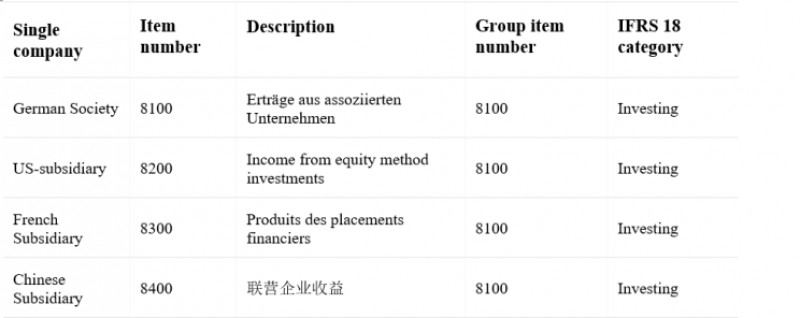
Practical example: Mapping income from associates
Let's consider the mapping of income from associates that are accounted for using the equity method:
This mapping shows how items from different individual companies are mapped to the same group item number and assigned to the same IFRS 18 category.
Step 3: Adjust consolidation processes
Consolidation processes must be adjusted to reflect the new IFRS 18 categories. This includes:
Review elimination transactions: Review how elimination transactions (e.g., elimination of intercompany results, elimination of intercompany transactions) affect the IFRS 18 categories. Elimination transactions may need to be adjusted to reflect the new categories.
Review non-controlling interests: Review how non-controlling interests are presented in the new IFRS 18 categories. This is particularly important as non-controlling interests are often presented in a separate line in the income statement.
Review consolidation adjustments: Review how consolidation adjustments (e.g., deferred taxes on consolidation differences) affect the IFRS 18 categories.
Step 4: Treatment of business segments
Many corporations are divided into different business segments. The transition to IFRS 18 requires that business segments be able to reflect the new categories.
Review segment reporting: Review how segment reporting works under IFRS 18. Do segments have to reflect the new categories? How are segments presented with the new categories?
Review cross-business segment transactions: Review how transactions between business segments are presented in the new categories.
Review allocation of central costs: Review how central costs are allocated to business segments and how this affects the IFRS 18 categories.
Step 5: Implementation in group reporting systems
Most corporations use specialized group reporting systems (e.g., SAP Group Reporting, Hyperion, OneStream) for consolidation and reporting. These systems must be adapted to reflect the new IFRS 18 categories.
Adapt data models: Adapt the data models to reflect the new categories. This may involve introducing new dimensions or hierarchies.
Adapt consolidation logic: Adapt the consolidation logic to take the new categories into account.
Adapt reporting tools: Adapt the reporting tools to reflect the new categories.
Automate processes: Consider how you can automate processes to improve efficiency and reduce errors.
Step 6: Retrospective application
A particular challenge is the requirement for retrospective application. This means that groups must not only present their 2027 financial statements in accordance with IFRS 18, but also the comparative period 2026.
This requires:
Adjusting historical data: Adjust historical data for 2026 to present it in the new IFRS 18 categories.
Ensuring comparability: Ensure that the data for 2026 and 2027 are comparable.
Providing explanations: Explain in the notes how retrospective application was carried out.
Challenges and best practices
Challenge 1: Consistency across companies
One of the biggest challenges is ensuring consistency across all companies. This requires clear guidelines and intensive communication.
Best practice: Develop detailed guidelines for classifying items in the new IFRS 18 categories. Communicate these guidelines clearly to all companies.
Challenge 2: Data quality
Another challenge is ensuring data quality. Incorrect or incomplete data can lead to errors in consolidation.
Best practice: Implement validation rules in your group reporting systems to ensure that data is recorded correctly.
Challenge 3: Timing
The transition to IFRS 18 must be completed by 2027. This is a tight timeframe for large corporations.
Best practice: Start planning and implementation now. Use the time until 2027 to proceed systematically.
Conclusion: Group-wide transformation required
The transition to IFRS 18 is a group-wide transformation for corporations. It requires adjustments not only in the individual companies, but also in the consolidation processes and group reporting.
Corporations that approach this transformation systematically and thoroughly adapt their processes and systems will not only ensure compliance, but also improve their group reporting and modernize their group reporting processes.
