
SAP FI/CO transformation: charts of accounts, mappings and system adaptations for IFRS 18
Why SAP decision-makers need to act now: strategies for a successful transformation from 2027 onwards.
Contents

The move to IFRS 18 is not only a question of financial reporting, it is above all a question of system architecture. For companies using SAP ERP or S/4HANA, it means a comprehensive transformation of their financial accounting and cost accounting. This article examines the technical requirements and shows how companies can adapt their SAP systems systematically.
The challenge: from the previous to the new income statement structure
The previous income statement structure under IAS 1 was relatively flexible. Companies could choose between the nature-of-expense method (GKV) and the cost-of-sales method (UKV). The classification of expenses and income was less strictly prescribed. As a result, charts of accounts and account assignments had often grown organically, without following a strict logic.
IFRS 18 changes this fundamentally. The four categories Operating, Investing, Financing and Taxes/Discontinued Operations are not optional: every item in the income statement must be clearly assigned to one of these categories. This calls for a redesign of the account assignment, which often entails a review and adjustment of the entire chart of accounts.
Step 1: analysing the existing chart of accounts
The first step is a comprehensive analysis of the existing chart of accounts. This includes:
Taking stock of all accounts: Document all accounts in your SAP system that record income or expenses. This should be done at the level of the individual account, not just at the level of account groups.
Classification by previous categories: Assign each account to the previous income statement structure (for example cost of sales, distribution costs, administrative expenses, finance expenses when applying the cost-of-sales method).
Identifying special cases: Identify accounts that record transactions which must be classified differently under IFRS 18. This includes, for example, accounts for income and expenses from associated companies, accounts for interest and dividends, and accounts for gains and losses from investments.
Reviewing granularity: Check whether the granularity of the chart of accounts is sufficient to represent the new IFRS 18 requirements. This is particularly important for companies that apply the cost-of-sales method, since additional information must be disclosed in the notes here.
Step 2: new account mapping for the IFRS 18 categories
Based on the analysis, you create a new mapping that assigns each account to one of the four IFRS 18 categories. In some cases, the clear categorisation may even render straddling accounts obsolete and make the creation of new accounts necessary. This is not trivial, as it requires conceptual decisions.
Operating
The Operating category covers all income and expenses from normal business activities. This typically includes:
-
Revenue
-
Cost of sales (material costs, personnel costs, depreciation of operating assets)
-
Distribution costs
-
Administrative expenses
-
Other operating income and expenses
Investing
The Investing category is new and includes:
-
Income and expenses from associated companies and joint ventures (accounted for using the equity method)
-
Income and expenses from investments in securities
-
Gains and losses from the sale of investments
-
Depreciation of investments
This is a significant change. Under IAS 1, these items were often classified under “other operating income and expenses” or “finance expenses”. Under IFRS 18, they must be clearly assigned to the Investing category.
Financing
The Financing category covers:
-
Interest income and interest expenses
-
Dividend payments
-
Gains and losses from foreign currency transactions that are financing-related
-
Expenses for the administration of financing
Taxes and Discontinued Operations
This category is relatively clear and covers income taxes and discontinued operations.
Step 3: adjusting the cost centre logic
The new income statement structure often also requires an adjustment of the cost centre logic in SAP. This is particularly relevant for companies that carry out detailed cost accounting.
Reviewing the cost centre hierarchy: Check whether your cost centre hierarchy can represent the new IFRS 18 categories. You may need to introduce new cost centres for the Investing and Financing categories.
Adjusting cost object accounting: If you carry out cost object accounting, you need to review how costs are allocated to cost objects. This is particularly important when costs from different IFRS 18 categories are allocated to the same cost object.
Reviewing internal allocations: Check how internal allocations (for example from service departments) are carried out. This can have implications for the classification of costs.
Step 4: data capture and granularity
The new income statement structure often requires more granular data capture. This is particularly relevant for companies that apply the cost-of-sales method, since additional information must be disclosed in the notes here.
Reviewing the capture logic: Check how data is captured in SAP. You may need to introduce additional capture fields or classifications in order to meet the new IFRS 18 requirements.
Automating capture processes: Consider how you can automate capture processes in order to improve data quality and reduce manual effort.
Introducing validation rules: Introduce validation rules to ensure that data is captured correctly. This can include automatic checks that prevent data from being classified into the wrong category.
Step 5: reporting tools and reporting processes
The existing reporting tools must be adapted to represent the new income statement structures. This includes:
Adjusting SAP Analytics Cloud (SAC): If you use SAC, you need to create new reports that represent the new IFRS 18 categories. This requires the adjustment of data models and the creation of new reports.
Adjusting SAP BI (Business Intelligence): If you use SAP BI, you need to create new queries and reports that represent the new categories.
Adjusting Excel-based reports: Many companies still use Excel-based reports. These must be adapted to represent the new categories.
Automating reporting processes: Consider how you can automate reporting processes in order to improve efficiency and reduce errors.
Step 6: testing and validation
Before you take the new structures into production, you need to test and validate comprehensively:
Unit tests: Test individual components, such as the account assignment or the reporting logic.
Integration tests: Test the integration between various systems and processes.
End-to-end tests: Test complete process flows from data entry through to report creation.
Validation against external data: Validate your results against external data, for example against data from your previous income statement structure, to ensure that the conversion is correct.
Piloting: Carry out a pilot with real data to make sure that everything works.
Practical example: reclassifying income from associated companies
To illustrate the complexity of this transition, let us consider a practical example: income from associated companies that is accounted for using the equity method.
Under IAS 1, this income was often classified under “other operating income” or “finance expenses”. This depended on the company’s interpretation.
Under IFRS 18, this income must be clearly assigned to the Investing category. This requires:
-
Identifying all accounts that record income and expenses from associated companies.
-
Reviewing how these accounts are currently presented in the income statement.
-
Adjusting the account assignment to assign these accounts to the Investing category.
-
Checking whether the reporting tools can represent this reclassification.
-
Testing and validating the new structure.
Conclusion: a systemic transformation is required
The transition to IFRS 18 is not just a question of account assignment: it is a systemic transformation that affects all levels of the SAP FI/CO landscape. Companies that approach this transformation systematically and adapt their systems thoroughly will not only ensure compliance, but also improve their financial reporting and modernise their systems.
The investment in this transformation is considerable, but the benefits are long-term. A modern, IFRS 18-compliant SAP landscape will form the foundation for an agile, data-driven finance function.



2. The business USP: the 3-stage deep-dive analysis
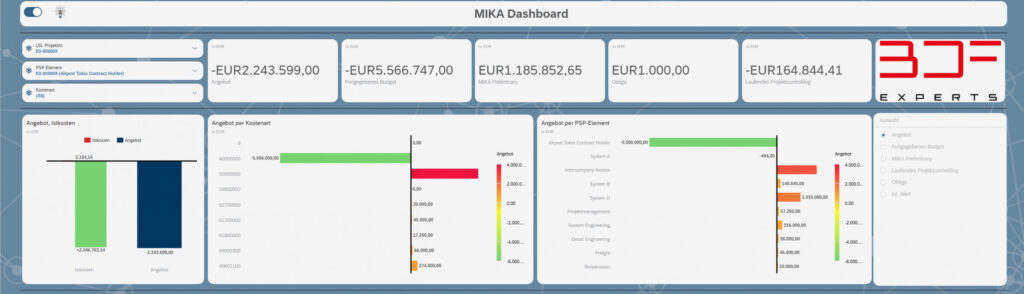
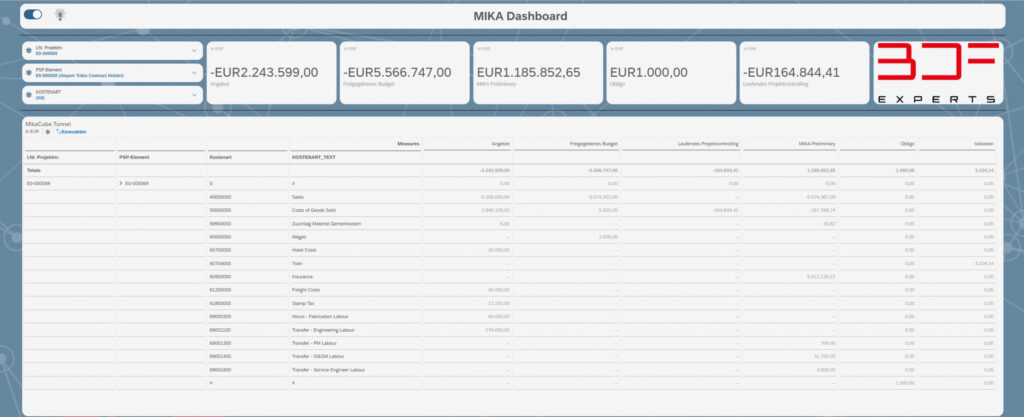
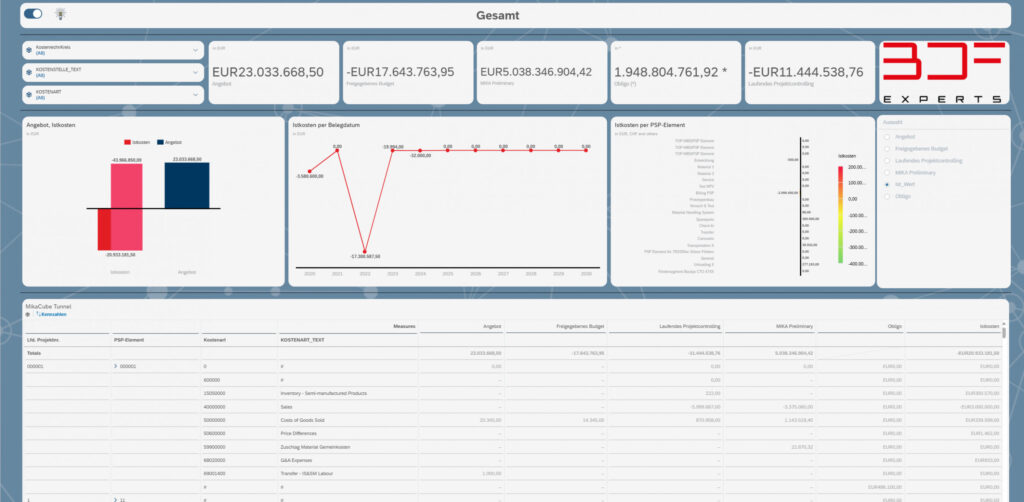
The central business benefit of MIKA for controllers lies in its logical and intuitive analysis structure, which enables quick navigation from the overall overview right down to the detail level. It divides the analysis into three dashboard pages that build on one another:
Stage 1: Overview (quick check)
The overview page delivers all the important Key Performance Indicators (KPIs) for the selected project at a glance. It serves as an initial summary and allows for quick orientation. Controllers can see immediately where action is needed, for example through deviations between the quotation, the budget and the ongoing project costing.
Stage 2: Detail (root-cause investigation)
From the overview, controllers can dive straight into the detail view. This page offers an in-depth analysis at line-item level. Here, detailed tables can be examined for a precise review of cost types, budgets and actuals. This level is crucial for precise root-cause investigation: where do the deviations come from? Which cost types have been exceeded? Intuitive filtering by WBS elements and cost types makes it possible to focus quickly on the relevant areas.
Stage 3: Total (strategic management)
The total view offers a consolidated look across the entire area, independently of individual projects or WBS elements. This strategic perspective is ideal for management reporting and for the overarching management of the entire portfolio. It makes it possible to identify trends and to make strategic decisions on a broader data basis.
This three-stage structure ensures that controllers can switch from the macro to the micro level in a matter of seconds, which massively increases efficiency in controlling.
3. User experience and future readiness
Using SAP Analytics Cloud as the front end guarantees a modern UX/UI. The dashboards are clearly structured and intuitive to use, which significantly increases acceptance among the end users, the controllers. An innovative detail that underlines MIKA’s user-centred design is the integrated theme switch. The ability to switch easily between light and dark designs ensures optimal readability in any situation and on any device.
Strategic outlook
MIKA is not a static solution; it is continuously developed further. Future enhancements plan to make the respective contribution margins from MIKA reporting available directly in SAC, in order to make the analysis even more comprehensive. Work is also under way on integrating an import model as an alternative data basis, in order to offer maximum flexibility for users’ varying requirements.
Conclusion: precision and speed in controlling
PPG-MIKA from BDF EXPERTS closes the gap between the data complexity of S/4HANA and the need for real-time transparency in project controlling. By making consistent use of the SAP Analytics Cloud Live Connection and high-performance CDS Views, SAP finance managers and controllers gain a tool that:
- offers speed (real-time data without replication).
- guarantees precision (a consistent data basis from S/4HANA).
- boosts efficiency (an intuitive, three-stage deep-dive analysis).
Learn more:
Would you like to find out how you can switch your project controlling to real time and significantly increase the efficiency of your concurrent costing? Request a live demo of MIKA now and experience the deep dive into your S/4HANA data.
Related articles

25 years of BDF EXPERTS: 25 years in numbers (20/25)

Webinar Recap: SAP In-House Bank and APM

A reliable cash status starts with the database
Finding
the right
solution together.
We are happy to answer your questions and to help you find the right services for your requirements.