Highlights:
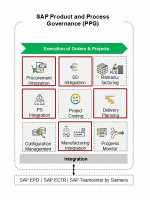
SD integration: Carry out your sales configuration (“high-level”) in SD and automatically generate the corresponding Technical Order Structure (TOS) to control all subsequent processes and complete SD order processing.
PS integration: With PS integration, you can first define the global scope of delivery and services in the Technical Order Structure (TOS) and then handle it across multiple projects in the respective delivery organisations. TOS items can be integrated into the WBS and network structures on a rule-based and automated basis.
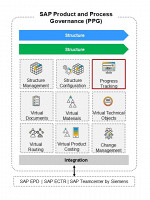
Project Tracking / Monitor:
So that you always keep an eye on deadlines in complex projects or product structures, Progress Tracking can be used for any level of detail at the lowest level in every project phase.
- In this way, for example, the creation of documents and material masters can be planned and tracked.
- Likewise, dates can be inherited within the PPG structure and calculated according to the selected scheduling profiles.
- In the Progress Tracking Cockpit, entire projects or parts of them can be selected for processing, which makes the work easier.
- More complex reporting requirements can also be mapped with additional data available.
Procurement integration:
The overall “Digital Purchasing” process offers you an end-to-end process chain from product development, through prototype construction, to series production.
Here a link is established between PPG product structures, material masters, general purchasing documents, item-specific purchasing documents and outgoing and ordered incoming documents. In the Doc Collector integrated into the purchasing transaction, the buyer receives an overview of all outgoing and planned (ordered) incoming documents. Through integration into collaboration platforms, the overall process can be fully automated and digitalised.
Industrial Engineering:
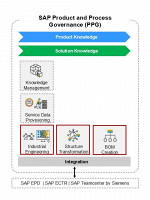
You can handle the concurrent development of products, their production resources and production processes either in a shared PPG structure or in separate PPG structures.
Depending on the overall process flow (MTS, MTO, CTO, CTO+, ETO), work preparation can be carried out independently of the customer order process, or only after order configuration or engineering. This produces, for example, logistics bills of materials, routings, work instructions, manufacturing parameters or purchase requisitions for the procurement of production resources.
Bill of materials creation:
Derive the bills of materials you need directly from the PPG data.
Material bills of materials can be generated in the respective desired
- usages,
- sales order bills of materials,
- project bills of materials,
- equipment bills of materials and
- functional location bills of materials.
This supports the Global Engineering and Global Production approach, in which production plants can be integrated within a global network via intercompany processes with the respective appropriate bill of materials type.
Structure transformation: Carry out structure transformations from the CAD structure through to the manufacturing structure, either manually or automatically, and trace them fully. In this way, for example, the aspects of different manufacturing processes in different plants and various logistical aspects of the assemblies can be mapped, or material items can be brought in that are not considered in engineering.
Manufacturing integration:
Generate planned orders, production orders, ERP routings and manufacturing bills of materials directly from the PPG.
In addition, manufacturing data packages can be configured using the SAP variant configuration. These can contain various manufacturing parameters and work instructions and be passed directly to the MES.
Delivery planning: Since the planning structures for production and procurement need not match the planning of deliveries, SAP PPG gives you the ability to map such situations in the delivery planning structure. There, so-called PPG shipping units can be defined, which are transferred into logistics processing through the automated generation of SD delivery documents.