
Product Lifecycle Management
Product Lifecycle Management with BDF EXPERTS connects product data, documents and processes centrally within the SAP environment.
Contents
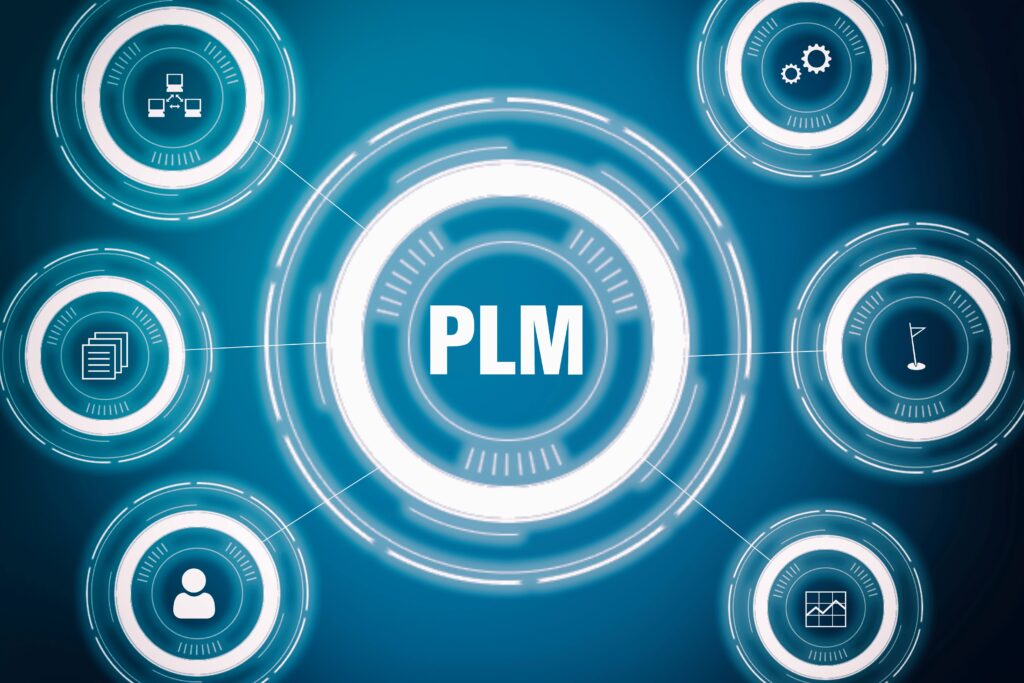
Product Lifecycle Management (PLM) describes the concept of centralised product data management and process control, integrated into all relevant areas of the company and serving as a „Single Point of Truth“ throughout the entire product life cycle. With this cross-departmental organisation, you can improve internal communication and coordination, handle sales order processes while saving time and costs, and thereby ensure the competitiveness of your company.
A digital product model
In the BDF PLM approach, the basis for efficient data management is a digital product model that is continuously enriched with data across all phases of the product lifecycle.
Thanks to central, structured management, everyone involved in your company, from development through manufacturing to the service or scrapping of the product, has the same knowledge, and redundancies or misinformation can be avoided.
PLM promotes efficient planning and control of product information throughout the company and, by integrating the data into all relevant business processes, leads to cost reductions and a sparing use of resources.

SAP Product and Process Governance (SAP PPG) offers Product Lifecycle Management fully integrated into SAP. By building a digital product data model, you can control all business processes around the product lifecycle from within SAP.
Even during product development, you can take advantage of comprehensive planning options with virtual objects and the integration of CAx data.

- With the Material Control Center (BDF MCC), material masters can be created and bills of materials generated automatically and on a rule-based basis.
- The Knowledge Control Center (KCC) offers the ability to collect all product and configuration knowledge and map it in a structured way. Through integration into procurement, manufacturing, service and maintenance or the project system, further objects such as purchase requisitions, production orders, functional location structures or WBS elements can be created automatically and dates tracked.
- With the concurrent costing (BDF SCC) in combination with Easy Cost Planning, you also keep an eye on costs in complex projects. Compare several forecast scenarios with one another, factor in current planned costs and derive targeted follow-up activities on that basis, to counteract deviations at an early stage.
- The Document Control Center (BDF DCC) also extends the document management system (DMS) and supports the planning, control, scheduling and dispatch of documents.
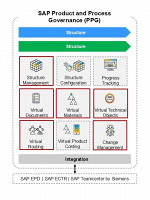
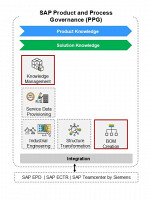
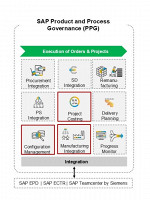
Highlights:
Structure management and configuration:
Use templates, module libraries or guided structure copies to create order-neutral or order-related structures easily and in a standardised way, with rule-based numbering. For example, this allows
- product and document structures to be built, classified and characteristic valuations to be inherited.
- The structures can be built without master data and contain various views such as costs, dates, engineering, manufacturing, project assignment, service data, shipping planning and so on.
- The master data can be generated directly from the structure later in the order processing.
Change management:
Use the comprehensive change management functions in PPG.
- Simple and complex multi-layer status networks in PPG.
- Integrated baseline management to display changes.
- Change all data generated with PPG using a change number.
- Validity control based on the SAP change number.
Virtual objects:
Use virtual objects such as virtual materials, documents, bills of material, routings, equipment or functional locations when building various structures.
- The virtual objects can be planned in terms of content and filled and managed over the lifecycle.
- This means you can already carry out extensive planning measures before the final objects exist or are generated.
- In addition, costing data can be maintained for a product structure as early as the development phase.
- The planning items can then be filled with existing objects or used to generate new objects.
Knowledge management:
Incorporate product and configuration knowledge directly into your product structures.
- With the help of knowledge management, configuration knowledge can be planned and generated directly, depending on class and object.
- By using the knowledge centres in PPG, this knowledge can be used directly in SAP variant configuration.
- By using characteristic spaces and knowledge types, you always keep an overview of the classes and objects used in variant configuration and avoid redundancies.
Bill of material creation:
Derive the bills of material you need directly from the PPG data.
- Material bills of material can be generated in the desired usages, along with sales order bills of material, project bills of material, equipment bills of material and functional location bills of material.
- This supports the Global Engineering and Global Production approach, in which production plants can be integrated in a global network via intercompany processes with the appropriate bill of material type.
- The Factory Control Center (FCC) also enables you to automatically transform design bills of material (EBOM) into manufacturing bills of material (MBOM) in order to integrate downstream logistics processes seamlessly.
Configuration management:
Map your configuration management with its project-related and project-neutral artefacts in the PPG structure.
- Artefacts can be reused across different orders and both the manufacturer view and the operator view can be mapped.
- A baseline can be created for each PPG structure, generated in a planned or unplanned way and displayed and compared via the change cockpit.
- With integration into functional locations and equipment, all aspects of configuration management are mapped.
Manufacturing / refurbishment integration:
Generate planned orders, production orders, ERP routings and manufacturing bills of material directly from PPG. In addition, production data packages can be configured using SAP variant configuration. These can contain various manufacturing parameters and work instructions and be transferred directly to the MES.
- In addition to manufacturing processes, refurbishment processes can also be mapped and recorded as maintenance records.
- This means that, using SAP variant configuration, the actual refurbishment scope can be determined after inspection and transmitted to the MES with the corresponding routing and components.
- Through integration with service and maintenance, equipment master records can be created, assigned or updated directly after refurbishment.
Project Costing:
With PPG Project Costing, you capture the entire project costs across all phases (from quotation creation to project completion).
- The planned costs can be planned modularly via the PPG to ECP (Easy Cost Planning) integration as early as the quotation or product planning phase.
- With quick cost estimation, cost planning can be created very efficiently via a simple entry or via references to existing material masters, quotations, purchase orders and so on.
If you want to create cost planning related to activity types, plants and a detailed costing sheet, the ECP integration can be used. The planned costs are then transferred to various planning variants in PS and can also be evaluated across multiple PS structures via reporting (MIKA = concurrent costing).
Related articles
25 years of BDF EXPERTS: 25 years in numbers (20/25)

Webinar Recap: SAP In-House Bank and APM

A reliable cash status starts with the database
Finding
the right
solution together.
We are happy to answer your questions and to help you find the right services for your requirements.